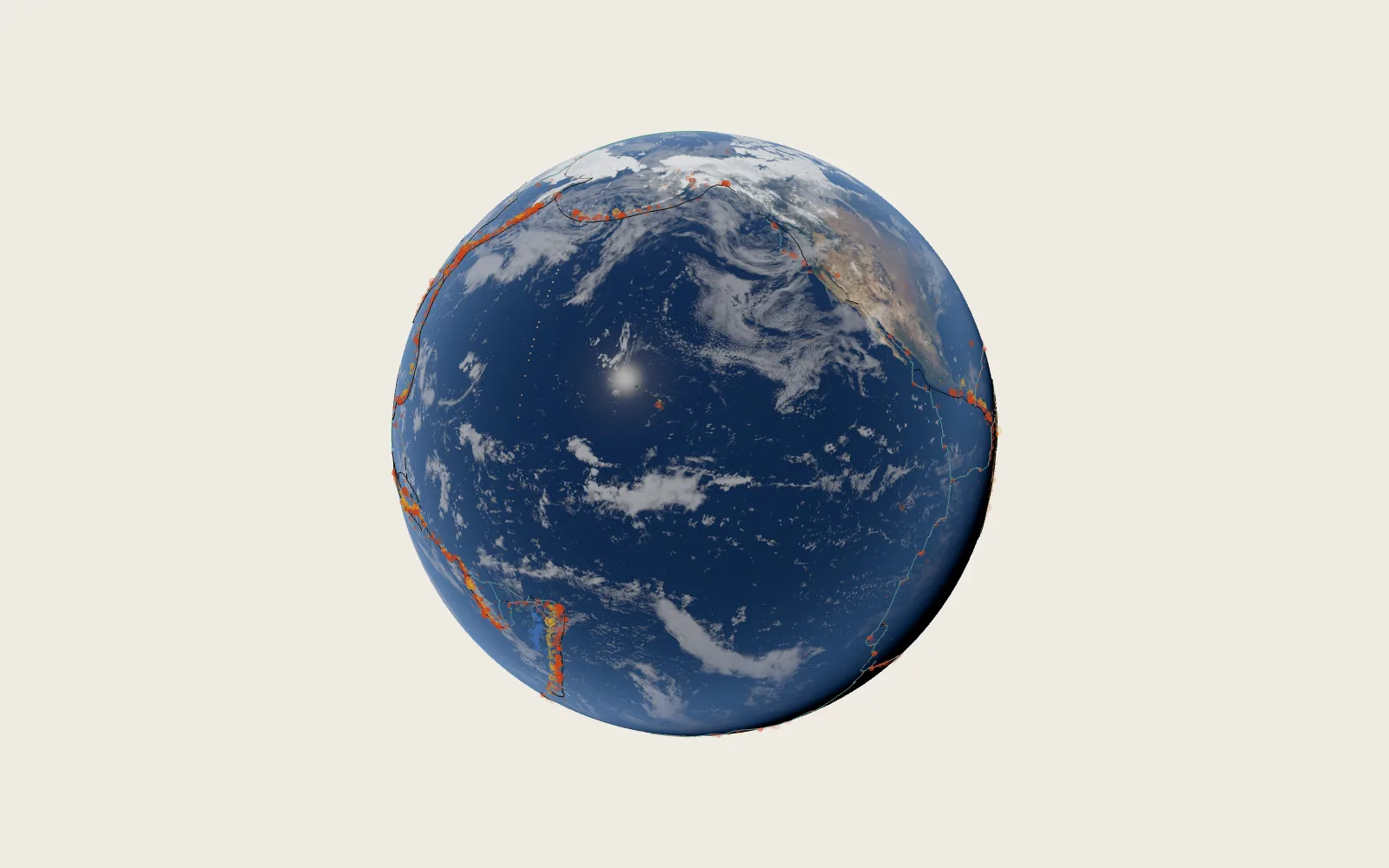
Plate 13 · Light & Sound
Why the Sky Is Blue
The sky is not reflecting the sea, and there is nothing blue floating in the air. The air itself is throwing the blue in sunlight in every direction.
Scroll
A Rainbow Inside White Light
Sunlight looks white, but it is a mix of every color — red, orange, yellow, green, blue and violet. Raindrops can pull them apart into a rainbow.
Light travels as waves. Red light has the longest waves; blue and violet have the shortest, less than two-thirds the length of red.
A meadow and the sky above it · sky colors computed from scattering
Bumping Into Air
Air is made of nitrogen and oxygen molecules, a thousand times smaller than a wave of light. As sunlight passes through, a little of it is bounced off in new directions by those molecules. This is called scattering.
The shorter the wave, the more it scatters: blue light is scattered nearly six times as much as red. So the light thrown in every direction is mostly blue.
Blue From Everywhere
When you look anywhere but at the Sun, you are seeing that scattered light. It reaches your eyes from every part of the sky, mostly blue, so the whole sky looks blue.
The blue is deepest high in the sky, away from the Sun. Near the horizon you look through much more air. Blue light heading toward you gets scattered away again on the way, while more red and green is scattered in, so the colors even out and the sky turns pale, almost white.
Why Not Violet?
Violet light has even shorter waves than blue and scatters even more. So why isn’t the sky violet?
Sunlight contains less violet than blue to begin with, and our eyes are not very sensitive to violet. Mixed together, the scattered light looks sky blue to us.
Red at Sunset
When the Sun is about to set, its light comes in sideways through a thick slab of air — about 38 times as much as when the Sun is straight overhead. Along the way almost all the blue is scattered out of the beam, leaving orange and red.
That is why the setting Sun is red, and why the clouds it lights glow red. Yet the sky overhead is still blue.
The same meadow, with the Sun near the horizon
One Sunbeam, Two Paths
Put noon and sunset side by side. In the top half the Sun stands 60 degrees high, and its light crosses only about 15 percent more air than when the Sun is straight overhead; about three-quarters of the blue gets through. In the bottom half the Sun is 1.5 degrees above the horizon, and its light slants through about 22 times as much air. Almost all the blue is scattered out of the beam, and what reaches your eyes is mostly red and orange.
The scattered blue is not lost. It lights up the sky somewhere else. That is why at sunset only the Sun’s side of the sky turns red, while the sky overhead stays blue.
Top: Sun 60° high · bottom: 1.5° · the same meadow
A Black Sky in Space
Above the atmosphere there is no air to scatter sunlight. Even in full sunshine the sky is black. The stars are still there, though the Sun’s glare makes them hard to see.
From the International Space Station, the atmosphere is just a thin blue line along the Earth’s edge. All of our blue sky fits inside that line.
Atmosphere drawn about 6 times thicker than it is
Your Turn
Move the Sun and watch the sky turn from blue to red. Add air or take it away. Then switch off “colors scatter differently” and see what the sky becomes.
Try thisSwitch off “Colors scatter differently” and lower the Sun: what color is the sunset now?
The Explainer Video
A short vertical film: a split screen follows the same sunlight at noon and at sunset, and ends with the name scientists give the effect — Rayleigh scattering.
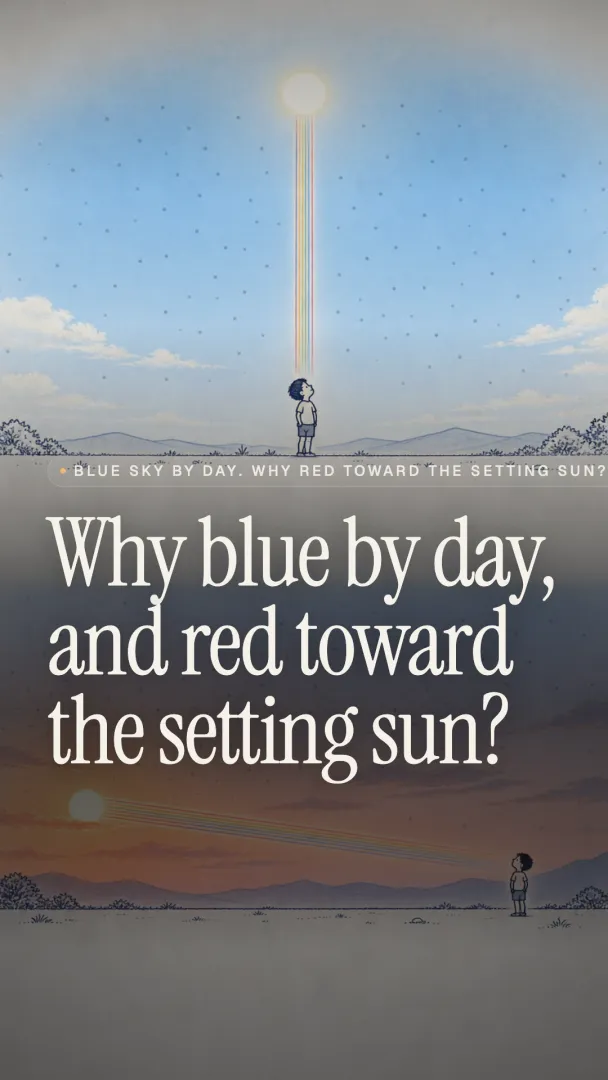
The pictures and narration are made with AI. It is an animation that explains the idea, not footage. Watch on YouTube ↗
What the model leaves out
The sky is computed at three wavelengths (red 680, green 550, blue 440 nanometers), with light scattered only once on its way to you, plus a little scattering by dust and droplets to give the Sun a halo. Ozone high up absorbs some yellow, orange and red light; with the Sun low, this is the main reason the sky overhead stays blue. The model includes it. In the real sky, light is also scattered several times over. In the “space” chapter the atmosphere is drawn about 6 times thicker, but the total scattering through it is kept the same.
A common misreading
The sky is not blue because it reflects the sea — the sky over a desert is just as blue. If anything it works the other way: the sea’s blue comes partly from reflected sky, and partly from sunlight that goes into the water and comes back out bluer, because water absorbs red light. Clouds are white because their droplets are much larger than a wave of light and scatter every color about equally.
Sources
- NASA Space Place: Why is the sky blue?
- National Weather Service: Why is the sky blue?
- Bodhaine et al. (1999): On Rayleigh optical depth calculations
- NASA Earth Observatory: Earth’s limb with a crescent Moon
Data
Rayleigh optical depth checked against Bodhaine et al. (1999); refractive index of air from Peck & Reeder (1972). Elevation and seafloor (globe colors): Terrain Tiles on AWS Open Data; ETOPO1, NOAA; GMTED2010 and SRTM, USGS.
Follow the question
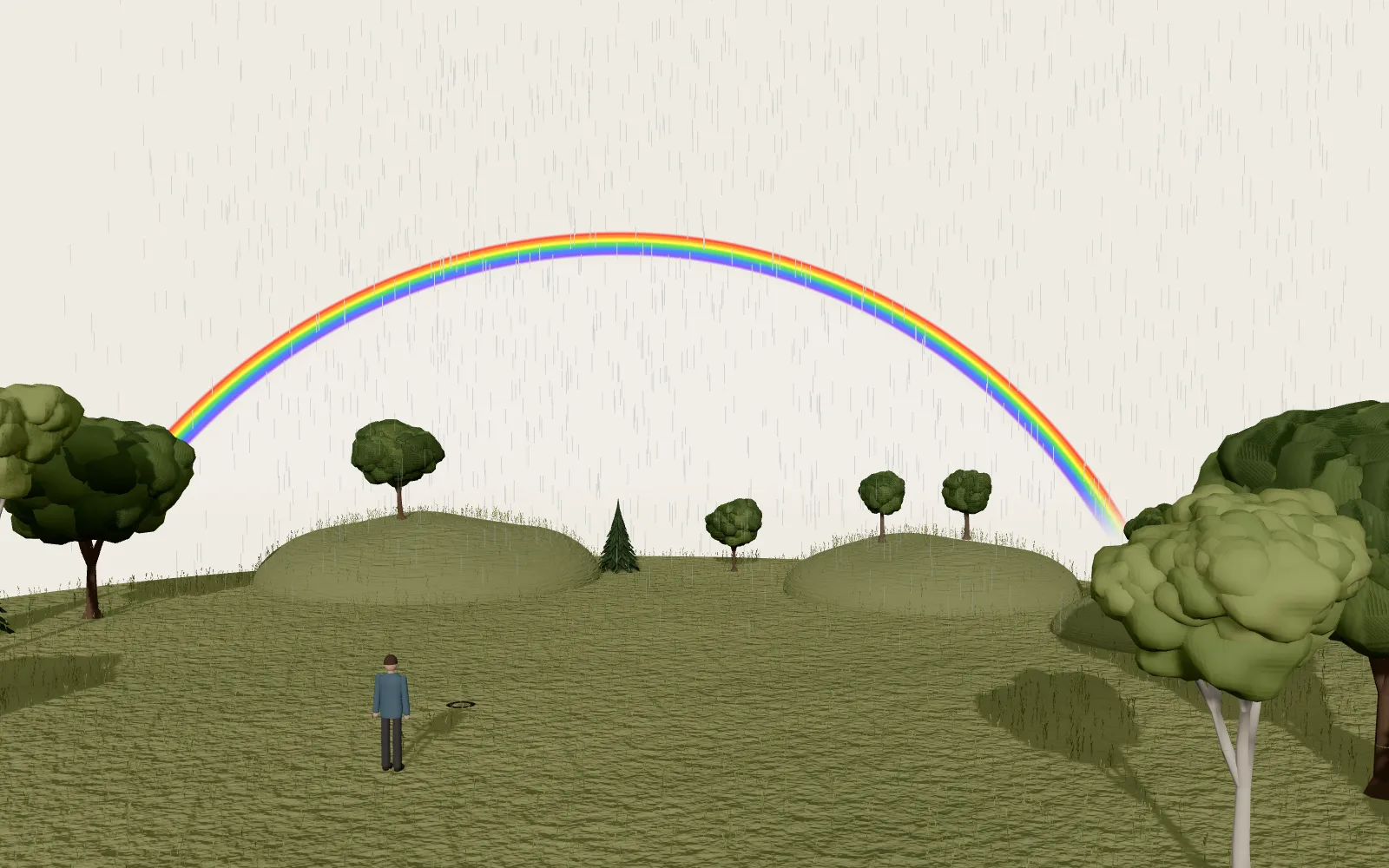 Plate 07Why a Rainbow Is RoundIt does not hang anywhere in the sky. It is a ring of light 42 degrees around the shadow of your own head.
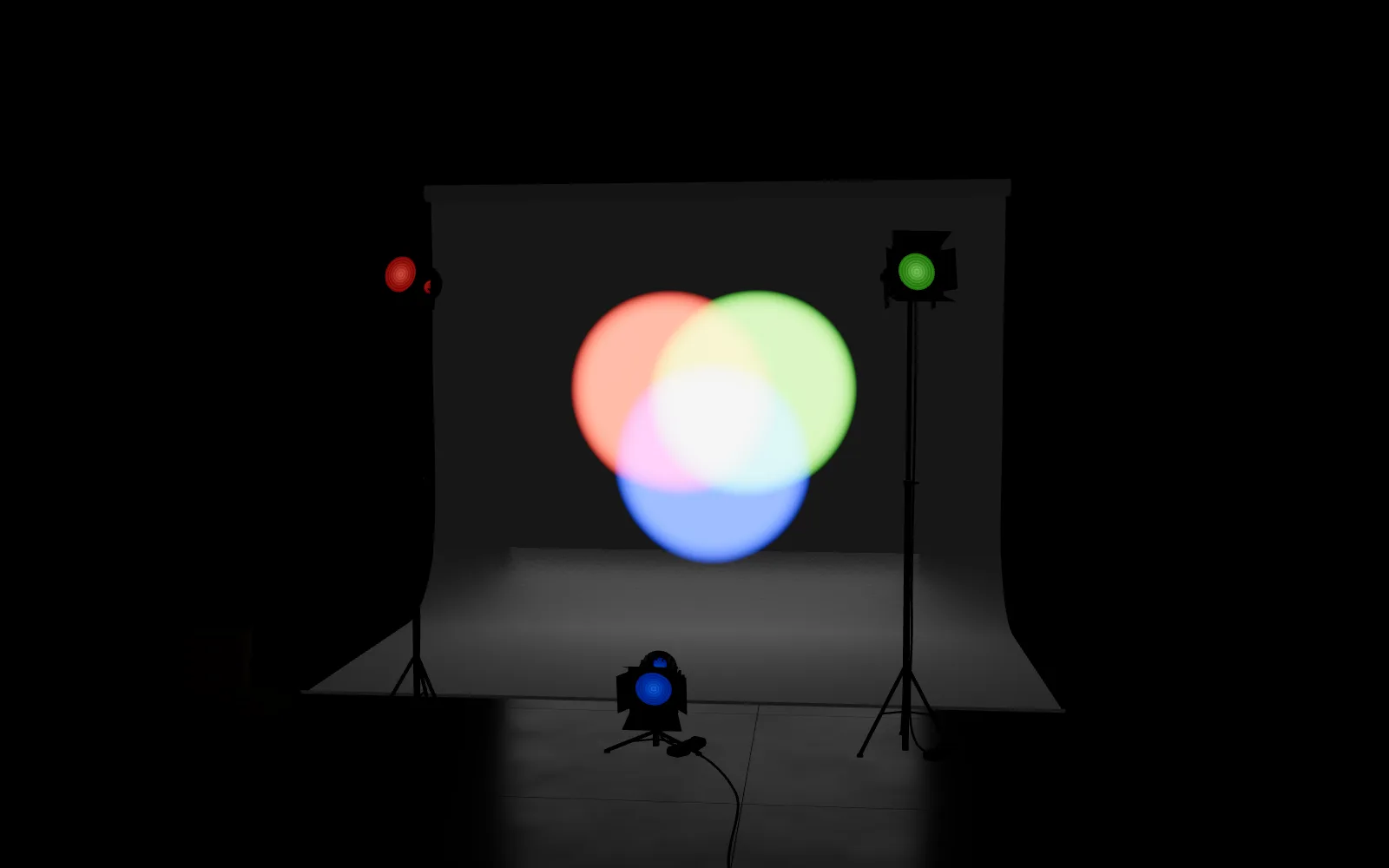 Plate 21Three Cones, a Million ColorsSunlight holds a smooth sweep of colors, but our eyes see it with just three kinds of cells. Every color you see is those three cells taking a vote.